Showing posts with label Link Building. Show all posts

Myths About Link Building - Rand Fishkin

on Saturday, 10 September 2016
Video Transcription of Rand fishkin's Whiteboard Friday edition

1. Never get links from sites with a lower domain authority than your own

What? No, that is a terrible idea. Domain authority, just to be totally clear, it's a machine learning system that we built here at Moz. It takes and looks at all the metrics. It builds the best correlation it can against Google's rankings across a broad set of keywords, similar to the MozCast 10K. Then it's trying to represent, all other things being equal and just based on raw link authority, how well would this site perform against other sites in Google's rankings for a random keyword? That does not in any way suggest whether it is a quality website that gives good editorial links, that Google is likely to count, that are going to give you great ranking ability, that are going to send good traffic to you. None of those things are taken into account with domain authority.

So when you're doing link building, I think DA can be a decent sorting function, just like Spam Score can. But those two metrics don't mean that something is necessarily a terrible place or a great place to get a link from. Yes, it tends to be the case that links from 80- or 90-plus DA sites tend to be very good, because those sites tend to give a lot of authority. It tends to be the case that links from sub-10 or 20 tend to not add that much value and maybe fail to have a high Spam Score. You might want to look more closely at them before deciding whether you should get a link.

But new websites that have just popped up or sites that have very few links or local links, that is just fine. If they are high-quality sites that give out links editorially and they link to other good places, you shouldn't fret or worry that just because their DA is low, they're going to provide no value or low value or hurt you. None of those things are the case.

2. Never get links from any directories

I know where this one comes from. We have talked a bunch about how low-quality directories, SEO-focused directories, paid link directories tend to be very bad places to get links from. Google has penalized not just a lot of those directories, but many of the sites whose link profiles come heavily from those types of domains.

However, lots and lots of resource lists, link lists, and directories are also of great quality. For example, I searched for a list of Portland bars — Portland, Oregon, of course known for their amazing watering holes. I found PDX Monthly's list of Portland's best bars and taverns. What do you know? It's a directory. It's a total directory of bars and taverns in Portland. Would you not want to be on there if you were a bar in Portland? Of course, you would want to be on there. You definitely want those. There's no question. Give me that link, man. That is a great freaking link. I totally want it.

This is really about using your good judgment and about saying there's a difference between SEO and paid link directories and a directory that lists good, authentic sites because it's a resource. You should definitely get links from the latter, not so much from the former.

3. Don't get links too fast or you'll get penalized

Let's try and think about this. Like Google has some sort of penalty line where they look at, "Oh, well, look at that. We see in August, Rand got 17 links. He was under at 15 in July, but then he got 17 links in August. That is too fast. We're going to penalize him."

No, this is definitely not the case. I think what is the case, and Google has filed some patent applications around this in the past with spam, is that a pattern of low-quality links or spammy-looking links that are coming at a certain pace may trigger Google to take a more close look at a site's link profile or at their link practices and could trigger a penalty. 

Yes. If you are doing sketchy, grey hat/black hat link building with your private networks, your link buys, and your swapping schemes, and all these kinds of things, yeah, it's probably the case that if you get them too fast, you'll trip over some sort of filter that Google has got. But if you're doing the kind of link building that we generally recommend here on Whiteboard Friday and at Moz more broadly, you don't have risk here. I would not stress about this at all. So long as your links are coming from good places, don't worry about the pace of them. There's no such thing as too fast.

4. Don't link out to other sites, or you'll leak link equity, or link juice, or PageRank

...or whatever it is. I really like this illustration of the guys who are like, "My link juice. No!" This is just crap.
All right, again, it's a myth rooted in some fact. Historically, a long time ago, PageRank used to flow in a certain way, and it was the case that if a page had lots of links pointing out from it, that if I had four links, that a quarter each of the PageRank that this page could pass would go to each of them. So if I added one more, oh, now that's one-fifth, then that becomes one-fifth, and that becomes one-fifth. This is old, old, old-school SEO. This is not the way things are anymore.

PageRank is not the only piece of ranking algorithmic goodness that Google is using in their systems. You should not be afraid of linking out. You should not be afraid of linking out without a "nofollow" link. You, in fact, should link out. Linking out is not only correlated with higher rankings. There have also been a bunch of studies and research suggesting that there's something causal going on, because when followed links were added to pages, those pages actually outranked their non-link-carrying brethren in a bunch of tests. I'll try and link to that test in the Whiteboard Friday. But regardless to say, don't stress about this.

5. Variations in anchor text should be kept to precise proportions

So this idea that essentially there's some magic formula for how many of your keyword anchor text, anchor phrases should be branded, partially branded, keyword match links that are carrying anchor text that's specifically for the keywords you're trying to rank for, and random assorted anchor texts and that you need some numbers like these, also a crazy idea. 

Again, rooted in some fact, the fact being if you are doing sketchy forms of link building of any kind, it's probably the case that Google will take a look at the anchor text. If they see that lots of things are kind of keyword-matchy and very few things contain your brand, that might be a trigger for them to look more closely. Or it might be a trigger for them to say, "Hey, there's some kind of problem. We need to do a manual review on this site." 

So yes, if you are in the grey/black hat world of link acquisition, sure, maybe you should pay some attention to how the anchor text looks. But again, if you're following the advice that you get here on Whiteboard Friday and at Moz, this is not a concern. 

6. Never ask for a link directly or you risk penalties

This one I understand, because there have been a bunch of cases where folks or organizations have sent out emails, for example, to their customers saying, "Hey, if you link to us from your website, we'll give you a discount," or, "Hey, we'd like you to link to this resource, and in exchange this thing will happen," something or other. I get that those penalties and that press around those types of activities has made certain people sketched out. I also get that a lot of folks use it as kind of blackmail against someone. That sucks. 

Google may take action against people who engage in manipulative link practices. But for example, let's say the press writes about you, but they don't link to you. Is asking for a link from that piece a bad practice? Absolutely not. Let's say there's a directory like the PDX Monthly, and they have a list of bars and you've just opened a new one. Is asking them for a link directly against the rules? No, certainly not. So there are a lot of good ways that you can directly ask for links and it is just fine. When it's appropriate and when you think there's a match, and when there's no sort of bribery or paid involvement, you're good. You're fine. Don't stress about it.

7. More than one link from the same website is useless

This one is rooted in the idea that, essentially, diversity of linking domains is an important metric. It tends to be the case that sites that have more unique domains linking to them tend to outrank their peers who have only a few sites linking to them, even if lots of pages on those individual sites are providing those links. 

But again, I'm delighted with my animation here of the guys like, "No, don't link to me a second time. Oh, my god, Smashing Magazine." If Smashing Magazine is going to link to you from 10 pages or 50 pages or 100 pages, you should be thrilled about that. Moz has several links from Smashing Magazine, because folks have written nice articles there and pointed to our tools and resources. That is great. I love it, and I also want more of those.

You should definitely not be saying "no." You shouldn't be stopping your link efforts around a site, especially if it's providing great traffic and high-quality visits from those links pointing to you. It's not just the case that links are there for SEO. They're also there for the direct traffic that they pass, and so you should definitely be investing in those.

8. Links from non-relevant sites or sites or pages or content that's outside your niche won't help you rank better

This one, I think, is rooted in that idea that Google is essentially looking and saying like, "Hey, we want to see that there's relevance and a real reason for Site A to link to Site B." But if a link is editorial, if it's coming from a high-quality place, if there's a reason for it to exist beyond just, "Hey, this looks like some sort of sketchy SEO ploy to boost rankings," Googlebot is probably going to count that link and count it well. 

So with that in mind, if you have other link ideas, link myths, or link facts that you think you've heard and you want to verify them, please, I invite you to leave them in the comments below. I'll jump in there, a bunch of our associates will jump in there, folks from the community will jump in, and we'll try and sort out what's myth versus reality in the link building world.

Best Ways to Earn Links for Free - SEO Tips

on Thursday, 25 February 2016

As I discussed in previous post : How to Earn Links for Free so here it continues ....

Best Ways to Earn Links for Free  

There's a better (free) link building strategy to build links to the pages you're attempting to improve search engine rankings for. In attempting to get a Web page to rank, there are a few key factors to consider:
  • Anchor Text - One of the most important things search engines take into account in ranking a page is the actual text a linking page uses to talk about your content. So if someone links to our washing machine manufacturer site with the text "latest washing machines", that will help us to rank highly for that keyword phrase, whereas if they had simply used text like "xyz company " to link to our site, we wouldn't enjoy the same ranking advantage for the phrase "latest washing machines".
  • Quality of the Linking Page- Another factor taken into account is the quality of the page that is sending the link; search engines allow links from high-quality, trusted pages to count more in boosting rankings than questionable pages and sites.
  • Page the Link is Aimed At- Many times, when people talk about your site they'll link to the home page. This makes it difficult for individual pages to achieve high rankings (because it's so difficult for them to generate their own link equity).
Image Courtesy : Elite Strategies
These are all elements we can't control in attempting to get other sites to link to us. We can, however, control all of these elements in linking to our own pages from our own content by.
  • Determine what anchor text to use.
  • Decide which page to point that anchor text at.
  • Ensure that the quality and content of the linking page is high.
Building external links to your site is important, but in focusing more of your efforts on the optimization of these internal links you can build quality in-bound links with rich anchor text to the proper pages, which will provide you with an unparalleled ranking boost for free .

How to Earn Links for Free : SEO Tips

on Wednesday, 24 February 2016
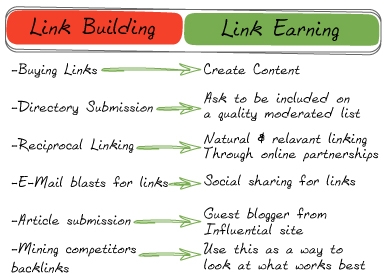
Link earning is an important aspect of content marketing and has been recognized as an effective means to increase the rankings of your website.

Why Link Earning is important?

Some argue that it makes them a bit of confuse over the  transition from the previous approach of link building to link earning.I would like to clarify this confusion by saying that there is a stark difference between earning and demanding.

The current set of visitors never likes to be misguided, instead they like point by point data or content.Link building as a whole, requires unique & relevant content targeting the right traffic. Both goes hand in Hand! In layman terms,Link building is a homogeneous mix of content and the readers.

Earning is definitely an arduous task, as it would require a strategic effort to bring your website to a respectable position but believe me the effort is worth it!
Everybody expects relevant results from Google. Having irrelevant or shady sites ranking in the top of the search results helps neither you, the visitor, nor Google the search engine. This is one reason why Google works hard to improve their algorithms in order to rank those that deserve to be there.

Image Courtesy : cognitiveseo

You could earn links by following:

  1. Creating epic content that was so engaging people naturally linked to it in the course of their editorial and online work;
  2. Promoting your content so that it gets in front of the right people, who are naturally motivated to share and link to your content;
  3. Building relationships that give influencers in your space comfort in the fact that your work is high quality and valuable enough to share.
Earning links still requires a strategic approach, but it’s less about creating artificial structures that result in links or treating links like a numbers game. The focus, as with other areas of SEO, is on quality and value. Still, there’s an active place for building: instead of focusing on building links, focus on building your brand. If you’re creating high quality content that you’re placing in priority outlets, links will naturally follow as a by product of that work.

How to Evaluate the Quality of a Link:

Google’s Penguin update underscored the importance of the quality of your links. Nothing can damage your site’s credibility and rankings faster than sketchy links. As a result, it’s critical to assess the quality of a potential link if you’re working to cultivate those connections. Here’s a quick guide of questions to ask before actively pursuing a link to your site:
  • Is the site topically relevant to my content?
  • Is the design and organization clean and professional?
  • What’s the quality of the content that it publishes?
  • Is the site overrun with advertising?
  • Does the site have an active community, as evidenced by comments, social media engagement, and mentions?
  • What does their incoming link profile look like?
  • Is there a clear editorial hand at work developing and selecting content?
  • Would I be comfortable associating my brand with this site?
By shifting your focus away from tactics that build links and instead investing in earning them, you’re creating a foundation that help you attract links from the top authorities in your space. One of the best strategies for doing so is through content marketing; in the next chapter, we’ll take a closer look at what you need to know about content marketing and inbound strategies that work.

Continues .....

Seo is not Dead - Start Link Earning Stop Link Building

on Thursday, 8 August 2013

Google: Guest Blogging Stop Link Building , Start Link Earning 


Hi,

Please Have a look .


Gave a highly entertaining and informative presentation about link building through guest blogging.

Guest Blogging Works, But You Have to do it Right

It’s a scenario that’s far too typical in the SEO world.  An awesome new tactic is discovered, word gets out, and it gets done to death, resulting in it not working anymore (sorry, but it’s true).

Link building through guest blogging has definitely suffered this fate.  Starting out as an incredibly effective means of generating high quality white hat links, over-use and poor implementation have resulted in bloggers cringing at inboxes full of poorly written, self-serving pitch requests, and ultimately ignoring the vast majority of would be guest posts.

However, guest blogging still works, and it works well, but it has to be done right.  The key is to stop thinking about it as link building, and start thinking relationship building.  Build real relationships with the real people running the sites, and the links will come.

Follow these six tips to make your guest posting more effective than you ever thought possible:

#1 Upgrade Your Research

The old way to find potential link sources was a simple Google search for the kind of blog you want a link from.  While this technically still works, this is exactly what your competition is doing, and you want to stand out from the crowd.

A much better way to research sources is through social media channels, especially Twitter, LinkedIn, and Pinterest.  Try searching using relevant keywords with modifiers like:

    Blog
    Blogger
    Editor
    Critic
    Etc.

#2 Don’t be Too Direct

The underlying themes to most unsuccessful guest blog pitch attempts are desperation and laziness.

Something along the lines of:

Hi Blogger,

Here is some content.  Give me a link.

From,

XXXX

Maybe that’s an oversimplification, but far too many guest outreach emails follow this format, and it almost never works.  Remember that you are reaching out to a real person, and it’s a huge turnoff when you immediately demand something.

The first time you contact a blogger, don’t pitch to them; get to know them.  Most bloggers are happy to help out people they like, but the only way to get there is to focus on the relationship before the link.

#3 Approach Through Social Media

Better yet, skip email altogether for the first contact.  Instead, reach out through social channels, where you are much more likely to get a response.

Twitter is one of the best social networks for finding and connecting with bloggers, and should be your first step in reaching out.  Start by following, then tweet directly to them, but don’t ask for a link on the first tweet.

#4 Personalize the pitch

Nothing will get your guest post denied quicker than sending a generic pitch.  Taking the time to personalize each pitch to the person you are sending it to will greatly increase your success rate, and is well worth the five extra minutes.

What if you don’t know enough about the blogger to make it personal?  Then it’s too soon to be pitching!

#5 Offer Value

The best way to get what you want is to give something back.  The primary value you should be offering is excellent content, but don’t stop there.

Some other great ways you can bring value:

    Promote and share their content on your social networks.
    Bring technical issues to their attention, such as dead links or broken forms.
    Leave comments and participate in discussions.

#6 Maintain the Relationship

Oftentimes when guest bloggers manage to get a placement, they pat themselves on the back, take the link, and are never heard from again.

You’ve put the effort into getting that link, but that’s just the beginning of the potential benefits you can gain from maintaining good relations.  If your content plays well, the blogger will be eager to publish more of your submissions in the future.  This is particularly good advice for agencies, who can leverage these relationships with multiple clients.

The key to effective guest blogging is to stop thinking in terms of links, and start thinking in terms of relationships.  Stop treating guest blogging as a numbers game, and the links will roll in.

NOTE: The content of this post has been taken from different online blogger suggestion, This for reference only ..