Why Images (Visual) Are a important in Social Media

on Wednesday, 18 May 2016
social media has become coveted real estate for brands. It’s a crowded space where consumers spend an inordinate amount of time. Getting heard among the noise can be challenging, and brands looking to differentiate themselves not only need a compelling message, but also - and more importantly -visual content that resonates.


More than a random stock image, employing visual social media - and doing it well - is a deliberative ,thoughtful process. Here are four tips to help you more effectively improve your social strategy with visual marketing.

Make it a Thoughtful Process

As stated above, choosing the perfect image is a careful, deliberative process. Explore how you want your audience to feel when looking at your imagery and think through the factors involved in creating a visual campaign that resonates with your audience. Some questions to ask when collecting images:
  • Who is my target audience?
  • What is the message that I am trying to get across to them through the image?
  • How can this image help them experience this feeling?
  • What are their needs?
As a brand, if you push something out to the consumer that’s not aligned with who you claim to be, they feel it. And they’re quick to recognize the separation between what was depicted and what was delivered. Keep it thoughtful and planned.

Forge a Consistent Visual Identity Across Platforms

When most people think of visual social media, Pinterest and Instagram come to mind. These social platforms paved the way for an important movement toward rich social-media images, but it’s important to extend your visual campaign beyond the basics to forge a consistent identity across platforms. Twitter, Facebook, LinkedIn, and others are also aligning to the idea of visual as a leading force. Video is on the rise, and brands have started using images to create short, engaging video clips as content for use on social channels. Keep your visual story consistent across platforms, and you’ll bolster your brand’s visual social identity.

Use Imagery — Not as a Supporting Asset but as the Message Itself

Great brands understand that the image is the message, particularly with how social platforms distribute visual content and how people consume it. Imagery is no longer a supporting asset but core messaging. Consider Apple’s visual campaign for the iPhone 6. The campaign focused on a series of images — photographs taken by an iPhone. The point of the campaign was to showcase the quality of the picture and nothing more. In this case, a single image was stronger than a brand name or pointing directly to the new features the phone provides.

Tie Visuals to Core Values and Mission

Influential brands use visual social media to personalize their companies. Visuals can provide a glimpse into company culture and personality, showcasing not only who you are as a brand, but also the persona of loyal fans and customers. Tying visual content to core values — and the sentiment that coincides with those values — makes it easy to tell your brand story. The key is to know your audience well and be clear about what you stand for and how you want to be perceived.

Content Credit : Heidi Besik

The 9 Most Common Local SEO Myths of Local SEO

on Friday, 22 April 2016

1.Deleting your listing in Google My Business actually removes the listing from Google.

Business owners will often question how they can get rid of duplicate listings on Google. One of the more common things people try is claiming the duplicate and then deleting it from the Google My Business Dashboard. When you go to delete a listing, you receive a scary message asking if you're sure you want to do this

The truth is, removing a listing from Google My Business (GMB) just makes the listing unverified. It still exists on Google Maps and will often still rank, provided you didn’t clear out all the categories/details before you deleted it. The only time you’d really want to delete a listing via GMB is if you no longer want to manage the listing.

Google confirms this in their help center article:
When you delete a local page, the corresponding listing will be unverified and you will no longer be able to manage it. Google may still retain business information from the page and may continue to show information about the business on Maps, Search, and other Google properties, including marking the business as permanently closed, moved, or open, depending on the information that’s known about the business.

2. Failure to claim your page means your business won’t rank anywhere.

I’m sure most of you have received those annoying phone calls that say: “Your business is not currently verified and will vanish on Google unless you claim it now!”

First of all, consider the authority of the people who are calling you. I can say with certainty they are not experts in this industry, or they wouldn’t resort to robo-calling to make sales.

The Moz Local Search Ranking Factors does list verifying your listing as #13 for making an impact on ranking in the 3-pack, but this is often because business owners add more data to the listing when they verify it. If they left the listing exactly how it was before verifying, the verification “status” would not likely impact the ranking much at all. We often see unverified pages outranking verified ones in really competitive markets.

3. "Professional/Practitioner" listings on Google are considered duplicates and can be removed.

Google often creates listings for the actual public-facing professionals in an office (lawyers, doctors, dentists, realtors, etc), and the owner of the practice usually wants them to disappear. Google will get rid of the listing for the professional in two different cases:
  • The professional is not public-facing. Support staff, like hygienists or paralegals for example, don’t qualify for a listing and Google will remove them if they exist.
  • The business only has one public-facing individual. For example, if you have a law firm with only one lawyer, Google considers this to be a “Solo Practitioner” and will merge the listing for the professional with the listing for the office. Their guidelines state to “create a single page, named using the following format: [brand/company]: [practitioner name].”
In the case that the professional has left your office, you can have the listing marked as moved if the professional has retired or is no longer working in the industry. This will cause it to vanish from the search results, but it will still exist in Google’s back-end. If the professional has moved to a different company, you should have them claim the listing and update the address/phone number to list their new contact information.

4. Posting on G+ helps improve your ranking.

Phil Rozek explains this best: “It’s nearly impossible for people to see your Google+ posts unless they search for your business by name. Google doesn’t include a link to your 'Plus' page in the local pack. Google doesn’t even call it a 'Plus' page anymore. Do you still believe being active on Google+ is a local ranking factor?”

No, posting on G+ will not cause your ranking to skyrocket, despite what the Google My Business phone support team told you.

5. "Maps SEO" is something that can be effectively worked on separately from "Organic SEO."

I often get small business owners calling me saying something along the lines of this: "Hey, Joy. I have an SEO company and they’re doing an awesome job with my site organically, but I don’t show up anywhere in the local pack. Can I hire you to do Google Maps optimization and have them do Organic SEO?"

My answer is, generally, no. “Maps Optimization” is not a thing that can be separated from organic. At Local U in Williamsburg, Mike Ramsey shared that 75% of ranking local listings also rank organically on the first page. The two are directly connected — a change that you make to your site can have a huge influence on where you rank locally.

If you're a local business, it's in your better interests to have an SEO company that understands Google Maps and how the 3-pack works. At the company I work for, we've always made it a goal to get the business ranked both organically and locally, since it’s almost impossible to get in the 3-pack without a strong organic ranking and a website with strong local signals.

6. Google employees are the highest authority on which ranking signals you should pay attention to.

Google employees are great; I love reading what they come out with and the insight they provides. However, as David Mihm pointed out at Local U, those employees have absolutely no incentive to divulge any top-secret tips for getting your website to rank well. Here are some recent examples of advice given from Google employees that should be ignored:
  • Duplicate listings will fix themselves over time.
  • Posting on Google+ will help your ranking (advice given from phone support reps).
  • If you want to rank well in the 3-pack, just alter your business description.
Instead of trusting this advice, I always suggest that people make sure what they're doing matches up with what the pros are saying in big surveys and case studies.

7. Setting a huge service area means you’ll rank in all kinds of additional towns.

Google allows service-area businesses to set a radius around their business address to demonstrate how far they're willing to travel to the customer. People often set this radius really large because they believe it will help them rank in more towns. It doesn’t. You will still most likely only rank in the town you're using for your business address.

8. When your business relocates, you want to mark the listing for the old location as closed.

The Google My Business & Google MapMaker rules don’t agree on this one. Anyone on the Google MapMaker side would tell a business to mark a listing as "closed" when they move. This will cause a business listing to have a big, ugly, red "permanently closed" label when anyone searches your business name.

If your listing is verified through Google My Business, all you need to do is edit the address inside your dashboard when you move. If there's an unverified duplicate listing that exists at your old address, you want to make sure you get it marked as "Moved."

9. Google displays whatever is listed in your GMB dashboard.

Google gives business owners the ability to edit information on their listing by verifying it via Google My Business. However, whatever data the owner inputs is just one of many sources that Google will get information from. Google updates verified listings all the time by scraping data from the business website, inputs from edits made on Google Maps/MapMaker, and third-party data sources. A recent case I’ve seen is one where Google repeatedly updated an owner-verified listing with incorrect business hours due to not being able to properly read the business hours listed on their website.

Content Credit : JoyHawkins

Impact of Content Delivery Networks on SEO

on Wednesday, 13 April 2016
What is a Content Delivery Network?

Contact Delivery Networks (CDNs) are a system of servers distributed throughout the world delivering web pages, and other web content (like video streaming) based on the users geographical location. This means that large amounts of content can be delivered quickly and without any interruptions.

For instance, if your website is based in Los Angeles, the people who are accessing it in San Francisco will receive the content faster than people accessing it from Shanghai. The farther away the person accessing the website or application is, the longer the load time and the more frustrating the user experience becomes.

CDNs have been a hot topic for businesses wanting to expand by reaching Internet users globally. It gives businesses the opportunity to reach out to millions of web users anywhere in the world in just seconds. Being able to put your company out in front of as many people as possible and quickly should be a priority for any business looking to grow, and when it comes to SEO, it must be a priority.

How do CDNs Work?

CDNs are made up of a network of servers referred to as “points of presence” or POPs. Each one of these servers (POPs) are spread out in locations all over the world. The CDN server that is located closest to where the user accesses it is called an “edge server.” When a user requests content from a website or application through a CDN, they will be connected to the closest edge server. This ensures the user will receive the best experience possible.

According to Incapsula, some of the benefits of using a CDN include:


  • Faster load times for content on your site (this is especially useful for increasing performance of your mobile site)
  • Image compression improves performance by reducing the size of images sent to the user
  • Session optimization reduces the number of open connections to your web server
  • Scaling quickly when there is increased or heavy traffic to your website
  • Ensuring the stability of your website by minimizing the risk of traffic spikes at point of origin
  • Better site performance and customer experience

CDNs allow you to cache (temporarily store) your websites content on a CDN so it is delivered from an edge server to the user faster than if it were to be delivered from the origin. This allows the content requested to travel from the nearest POP and back, instead of having to travel all the way from the website’s origin server and back.

Another benefit of using a CDN is that CDNs will remove and update (purge) your content regularly, to ensure the most relevant and current content is being delivered, even if the website content is cached. This process is referred to as content invalidation.

How do CDNs Help SEO?

CDNs improve the speed and quality of content that is delivered to the user. CDNs should be seen as part of the solution for search ranking as it is applied to page speed and efficient content delivery, but it is not the only thing that needs to be done to increase search ranking. Think of CDNs as a way to improve upon the technical ranking factors for SEO.

For instance, CDNs help to ensure each version of your website across several servers and locations are identical. CDNs use caching algorithms and canonical headers to help enhance SEO of your website by combatting duplicate content creation issues. Remember, as CDNs purge content so the most recent and relevant content loads first, they must do this across every cached version of a site.

How CDNs Make Your Site Safer?

Having the site load from several servers and from several locations will not only improve your site’s health, but again it is a huge benefit for SEO by increasing the load time of your website.

The risk of attack on your site will also decrease, because of the multiple servers located in multiple geographical locations. Having multiple servers will also help prevent your website from crashing by dividing the load time up among the various servers.

Should You be Using a CDN?

CDNs can benefit anyone with a website or mobile application that could be requested by multiple users at a time. CDNs are especially useful for websites that have a lot of content and varying content types, and complex websites with users from multiple geographical locations. Most importantly, CDNs will increase site load speed, which will increase your search ranking.

On the other hand, if you are going to implement a CDN, make sure that you implement it correctly. Contact a professional to help you implement your CDN, because an incorrectly implemented CDN can compromise your site’s SEO and usability.

Original Source : Adobe

Micro-Conversion vs. Macro-Conversion

on Thursday, 7 April 2016

  • The Personalization Gap Is Wide


It indicates that consumers would welcome real-time offers in stores and online. Yet, very few marketers are using technology to achieve micro-level personalization, with almost one-third saying that they do not personalize at all. The result? Most consumers find that the personalization they do see is superficial and annoying. They want to use technology to solve problems and find services quickly, but many organizations are falling short.
The stakes are high. Companies that can deliver the right experience to the right person will become the go-to brands, leaving other brands far behind.

  • The Right People + the Right Data = the Right Experience Design


A key element in an engaging customer experience is continuity across devices and platforms. Often, a fragmented customer experience is a reflection of the structure within an organization. Different platforms within a company present a challenge - they may only be able to optimize pieces of the whole experience, and they use different KPIs (key performance indicators) to do so, leading to multiple personas for the same customer, competing offers on different channels, and other poor experiences.

Integrated data systems, where the same solutions that harness all of the data are used to optimize and personalize the experience, will help marketers understand how their customers experience their brands as a whole. A unified platform makes it easier for all team members to see the same data and analysis and to work together to create a focused, optimized experience.

The best experiences will be forged when people are able to listen to the data and, from it, understand how the customer thinks and feels about the brand. The skillsets needed are an intersection of business, science, and liberal arts skills. Only 10 percent of companies have established customer-experience teams - people who combine the art of design with the science of optimization to create personalized experiences that drive engagement and revenue. Companies that invest in agile and efficient technologies - and the right people to use them - will become the competitive leaders of the future.

  • Personalization Is a Process, Not an Event


Leading personalized experiences are evolved with an iterative process. They begin by bringing data together to map customer behaviors and identifying top-performing areas and bottlenecks. A prototype experience is developed from this initial map.

Most companies would stop here, but significant gains are realized by continued analysis of performance and revisions to the experience. From there, one can move on to automate the experience. This is necessary to achieve personalization at the micro-scale needed to reach every customer on all of their channels and devices.

  • The Internet of Things Will Widen the Gap


In just a few short years, the mushrooming number of devices on the Internet of Things will create new data streams and a torrent of new information. This data can potentially give an even clearer view of customers lives, if marketers can meet the challenge of making sense of this massive amount of data. These new devices will compound today’s marketing problems and make it critical to implement strategies now before the avalanche begins. Today’s integrated technology supports these new levels of data analytics, content management, testing, and optimization and will allow scaling of personalized experiences at the new levels of data input that are coming soon.

Higher Ranking Factors Revealed By Google

Google made very interesting announcements about SEO recently..

#1: Links and content are Google's #1 and #2 ranking factors

As you may know, Google uses over 200 ranking factors to rank websites.And SEO pros have long known that backlinks make up a good chunk of these 200 factors.

For example, three of Google's most well-known ranking factors are link-related: 1. the number of links pointing to your site, 2. the anchor text of those links and 3. the authority of those links.

That's why any SEO agency worth their salt tells their clients that link building is the KEY to first page Google rankings.

So it was refreshing to hear Google confirm that links and content were Google's two most important ranking signals.

When a Search Quality Senior Strategist at Google (Andrey Lipattsev) was asked what the top two ranking factors were, he answered:

"I can tell you what they are. It is content. And it’s links pointing to your site."

So the next time you see an alarmist "link building is dead!" article, you can chuckle to yourself...
...and then get back to the important task of link building.

Key Takeaway: Despite the buzz about social signals, backlinks remain the core of Google's algorithm. If you want to build more white hat links to your site, I highly recommend watching this step-by-step video case study.

Announcement #2: Google uses CTR and user experience in their algorithm

Yes, links are still king today...and will likely remain Google's top ranking signal for years to come.

That said, Google is consistently adding new ranking signals into the mix.And in a recent talk, Google engineer Paul Haahr revealed some of these new signals.Specifically, Paul revealed that:

1. Google runs A/B tests with the SERPs. So if you drop or go up 1-2 spots, it may have nothing to do with links, on-page SEO, etc. It could be a test.

2. Google definitely uses click-through-rate (CTR) data as a ranking signal.
This shouldn't come as a huge surprise.

After all, if a site ranks #2 in Google -- and hardly anyone clicks on that result -- it probably means the page is irrelevant.

And if they DO click on it -- but hit their "back" button after 2 seconds -- it tells Google that it's a low-quality result.

On the other hand...

If your page gets an above-average amount of clicks -- and people stick to your page like superglue -- this tells Google that people like your page.And it's likely to get a rankings bump.

Key Takeaway:Google pays attention to how searchers interact with your site. A high CTR and time on page may boost your rankings.

And for a bunch of super-practical strategies that you can use to optimize for CTR and time on page.

Is it Time for Growth Hacking to Rebrand?

on Saturday, 2 April 2016
“Well, the one thing that never quite sat right with me is the word hacking. There are a number of things implied by that word that don’t align with the intended growth hacking definition. I argue that we must replace the word hacking with something more appropriate.My rationale is as follows.”-Andy Ramnn

1. Hacking implies shortcuts and quick fixes.
Anyone obsessed with business growth knows that sustained growth is only achieved through a dedication to understanding and maintaining maximum relevance and appeal to a target audience. Doing so requires the disciplined and relentless application of specific methodologies to drive engagement, conversion and loyalty. Furthermore, additional methodologies must be deployed to detect and adapt to changes in the needs and orientations of that audience.

Great copywriting is not a quick fix. Disciplined A/B testing is not a quick fix. White hat SEO is not a quick fix. Focusing on the customer to optimize engagement and drive down is not a quick fix. And, this applies to all companies, not just startups.

This is a deep process. A long(er) term strategy. This is not hacking.

2. Hacking implies nefarious methods.Being highly relevant and accessible to your target audience doesn’t come from gaming the system. Black hat SEO techniques to artificially boost page rank are dying off fast as viable means to drive sustainable growth. Real growth hacking strategies not only create better, more relevant content and offerings for customers, they make the web better as a whole. And as more companies engage in a process of continuous optimization (improvement), the entire web improves.

Growth hacking techniques are not shady, deceitful, or ill meaning. They require creativity, analytical thinking, and social prowess to achieve a singular goal.

This is not hacking.

3. The term hacking causes confusion and adoption of false principles.
The term is misunderstood, which means the benefits of growth hacking becoming widespread, or even universally adopted, is slowed unnecessarily.

If the perception among company leaders and marketing generalists is that growth hacking involves quick-fix and black hat methodologies, then the adoption of real techniques to drive customer-oriented optimization stalls. If growth hacking makes for a better web as a whole – as I argued previously – then slowing the adoption of its true methods is bad for the web.

This is the point where I confess that I don’t know if I have anything better in mind. I have no quarrels with growth engineering as a term of art. Growth marketing is also somewhat apt, though less complete in terms of what it encompasses.

In the end, growth hacking may stick. I can probably live with that. Do you know a growth hacker who would prefer to be called a growth engineer? You’re at a party. You introduce yourself to someone. You tell your new companion that you’re a growth hacker. What you do is witchcraft, unknowable to ordinary mortals. You are the James Bond of the deep web. You are mysterious, and important.

Or, you say that you’re a growth engineer. You’re the nerd in the marketing department.
See the difference?

The point is to continuously make the web a better place. This happens when companies focus on being more relevant, more accessible and more frictionless. If this is the true collective ethos of growth hacking, then perhaps it’s time to redefine the word hacking, rather than rebrand our discipline.

About Author: Andy is the President & General Manager of Alexa.

Google pulls Gmail mic drop April fool joke after ruining many lives

on Friday, 1 April 2016
Looks like the joke's on Google, or is it? The search engine giant -- known for inserting jokes and hoaxes into its products ceremoniously on every April fool's Day -- was caught foot in mouth on Friday when an ill-conceived joke backfired, ruining many lives in the aftermath. The prank: a mic drop option added to Gmail that automatically affixed a gif of a minion tossing away a microphone when you hit send. The problem: it led to more headaches than laughs.

Google has acknowledged the 'joke wasn't funny' and pulled the plug on it now, but the damage has already been done.

"Well, it looks like we pranked ourselves this year. Due to a bug, the Mic Drop feature inadvertently caused more headaches than laughs. We're truly sorry. The feature has been turned off. If you are still seeing it, please reload your Gmail page," said Google on its official blog .

So what's the fuss all about, you ask? Well, Google silently replaced Gmail's 'send and archive' option with a 'send and mic drop' option this morning. Typing in an email (or possibly replying to one) and quickly hitting on it attached a gif to your email (a minion dropping the mic) inadvertently letting the receiver to know, 'hey, this conversation' just ended.

"Gmail is making it easier to have the last word on any email with Mic Drop. Simply reply to any email using the new 'Send + Mic Drop' button. Everyone will get your message, but that's the last you'll ever hear about it. Yes, even if folks try to respond, you won't see it," Google said while announcing the feature earlier in the day.

But, people ended up sending those emails to bosses and other people who might not really appreciate the joke.

"Thanks to Mic Drop I just lost my job. I am a writer and had a deadline to meet. I sent my articles to my boss and never heard back from her. I inadvertently sent the email using the "Mic Drop" send button.There were corrections that needed to be made on my articles and I never received her replies. My boss took offense to the Mic Drop animation and assumed that I didn't reply to her because I thought her input was petty (hence the Mic Drop). I just woke up to a very angry voicemail from her which is how I found out about this "hilarious" prank,"said one user .

"Yes, it's a funny April fools joke, but not when it's actually screwing up my important email correspondences," wrote another user .

Source India Today

"WHITE HAT SEO" Not about Gaming Google - 2

on Wednesday, 30 March 2016

#3: HELP GOOGLE KNOW WHAT YOUR CONTENT IS ABOUT BY GETTING VOTES OF CONFIDENCE

Google needs to know what your content is about in order to place it in the right SERPs for the right search terms.

One way it does this is through on-page signals–things like the inclusion of keywords in the URL, title, body content, etc.

Another way is through on-site signals— internal links from related pages on your site using anchor text that is descriptive of the content (i.e. it includes the target keyword).

And then there are off-site signals–inbound links from 3rd party trust-worthy sites that have related content linking to your content. A 3rd party citation of your content tells Google that a real, live person who created it thinks your content truly is about “xyz” (aka your keyword).

This is the origin of SEO’s spammy reputation. Bad-actors manipulated off-site signals by fabricating inbound links with things like link farms—clearly not living, breathing humans giving a vote of confidence that the content is indeed about what you claim it to be.

As a result, Google has put great effort into knowing when an inbound link is from a quality, trust-worthy site, versus a fabricated link purely for manipulative gain. The former helps you. The latter hurts you.

So when you hear the term “link building,”forget those old school black hat tactics. The game has changed. When done right, link building can be an extremely powerful way to boost search rankings. As a bonus, it could drive referral traffic too. 

The key here is in building relationships and reaching out to bloggers and journalists to let them know about your awesome content.We’ll need to write a whole other post on white hat link building.

BUT THE POINT IS -

If you followed technique #1 , you’ll have content that’s in demand–and the bloggers you reach out to will know their audience enough to know that.

If you followed technique #2 , bloggers will appreciate the resourcefulness of your content and be more likely to cite it when it is relevant and complimentary to the content they are creating.

IN WHITE HAT
  • Reach out to influencers to let them know about your content, pointing out why it might add value to their content.
  • Personalize your outreach in a genuine,one-on-one way that shows you know the blogger.
  • Be patient. Building mutually beneficial relationships takes time. 
IN BLACK HAT
  • Send mass emails to influencers with no personalization. It won’t be effective. It won’t get you to the top of Google. And you’ll burn bridges in the process.

"WHITE HAT SEO" Not about Gaming Google

on Tuesday, 29 March 2016
SEO isn’t about gaming Google. It’s simply about creating content that people want and that satisfies their search intent.Looking at SEO from this perspective can make it easier to understand and easier to execute white hat SEO techniques. By putting aside the spammy tactics of yesteryear, you can produce and publish customer-focused content without that scammy vibe.

#1: USE KEYWORD RESEARCH TO DISCOVER CONTENT DEMAND


A little keyword research can go a long way in helping you understand what your audience wants. Not only will you find topics that are frequently searched, you’re also likely to stumble on search language they are using that you might not have anticipated. One reason for this— your knowledge and expertise in your industry is deeper than theirs. The language you use is probably industry jargon that your audience doesn’t use. This is a great opportunity for you to find long tail keywords that your audience can understand, and create content that speaks to them.Creating content using language your customers use is as white hat as it comes. Forget stuffing your content with a single keyword over and over again. This is about meeting customers on their turf, speaking to them naturally and in terms they understand.

IN WHITE HAT -
  • Choose to target keywords that are fairly popular. The ease of ranking for those keywords will depend on the competitive strength of your site. Be realistic in how high of a competition level you can take on and still get results.
  • Include the target keywords in all the right places—URL, title tag, alt images, body content, etc.
  • Use other keywords that are related to your target keyword within the body of your content.
  • Use the target keyword in the anchor text of internal links to the new content.
IN BLACK HAT -
  • Don’t — aim for quantity over quality. With all the searches Google receives every day, you can be certain its algorithms understand synonymous phrases. Instead of repeating the same keyword phrase as often as possible, use like-keywords to reinforce what your content is about.

#2: CREATE SEO CONTENT THAT ANSWERS THE SEARCH INTENT


You don’t need to be a technical genius to do SEO right. Like most marketing disciplines, a little bit of empathy for the user searching can go a long way to getting results in SEO.

Think from the perspective of the searcher.
  • What are they looking for? 
  • What are the problems they are seeking advice or solutions to?
  • Are they looking for advice, or are they looking to buy something?
Search intent tends to fall into one of these categories:
  • Learn something
  • Find solution to a problem 
  • Purchase something
When evaluating your list of keyword opportunities, think about whether a person searching That phrase is hoping to learn something, find a solution to a problem, or make a purchase.

The phrase they’ve entered reveals a lot about their intention.

When you create your SEO content be sure to give users what they are looking for. If they are looking for an educational “how to” article,don’t create content that pushes a sale.

IN WHITE HAT -
  • Think of your content as a Q & A. The keyword query is the question. Your content is the answer. 
  • Be a useful resource by giving the searcher what they want.
  • Be clear in your title tag and meta description about what your content promises.
IN BLACK HAT
  • Don’t— bait and switch the searcher with misleading click-bait titles. Your title should always tie directly to your content. If it doesn’t, the visitor is more likely to bounce, sending Google a signal that your content didn’t serve their search interest. As a result, Google will drop your position in the SERPs like a hot potato.

Source : Alexa e Book

How did Google Maps brand JNU as Antinational?

on Monday, 28 March 2016
Google Map is showing Jawaharlal Nehru University if you search "anti-national" or "sedition ". For a company like Google, this is a major problem. Suddenly it has found itself in middle of the loaded -- and viciously political -- debate about JNU and some of its students. And it is a debate that Google would like to avoid. So how did it happen? Why one of the most used products of the company has suddenly gone wonky and is branding JNU with certain words?


The Map Maker, a Google tool, that gives people ability to edit map information and supply additional information seems like the obvious culprit. It looked like someone made some JNU related edits in Map Maker so that Google deems it "anti-national". After all, in the past we have seen Google Map vandalism through Map Maker. Remember the Android logo pissing on Apple logo? That was done through Map Maker.

But in this case, Map Maker is not at fault. The problem this time seems to be the Google Maps algorithm and how Google uses data from all of its services to improve what it can offer to consumers. The problem in this case is with the keywords that Google deems important.

Google is a company that utilises the user data in a big big way to power its services. Almost all Google services, from Google search to spam filters in Gmail, use the data generated by users to improve services. In the case of Google Maps, the company apparently sees a lot of keywords, even outside Google, and apply them to various installations in Google Maps to give richer information to users.

This has seemingly happened in the case of JNU, which is being described by many people as "anti-national". For example, in the reviews for JNU on Google Maps there are tens of spam entries describing JNU as anti-national.

Although Google has officially not commented on how and why "anti-national" keyword is pointing towards JNU, some information has trickled out. A senior Google executive aware of the JNU issues told IndiaToday.In that it is definitely connected to keywords.

"This is a bug. Google Maps results take signals from many points on the web -- including top news outlets. The terms "Anti National and "Kanhiya Kumar" and JNU have been in the news so much recently that they became associated in Maps which is why this is triggering. This is a bug and we're working to fix this as quickly as possible," said the executive.

The fact the issue is not due to the Map Maker edit but because of keywords also gets confirmed by the time Google is taking to fix it. It is possible that to fix the issue, Google may have to change the way it processes "signals" in Google Maps, and tweak algorithm. That will not only require some serious work but also several approvals from the company headquarters in Mountain View. So for now, it seems JNU will continue to be "anti-national" on Google Maps, at least for another several hours or even a few days.

Source : India Today

SEO,PPC Updates: Google Removes Right-side Ads & Drops Flash Ads

  • No More Ads on the Right-hand Side of SERPS

Google “We’ve been testing this layout for a long time, so some people might see it on a very small number of commercial queries. We’ll continue to make tweaks, but this is designed for highly commercial queries where the layout is able to provide more relevant results for people searching and better performance for advertisers.”

There are only two exceptions to this: Product Listing Ads (PLAs) and Knowledge Panel ads. They may show a fourth ad above the search results now, but only for “highly commercial queries” such as “hotels in New York City” and “Car Insurance.”

How is this affecting people in the industry? For smaller advertisers, this change has had a minimal impact. They haven’t seen much of a change in clicks. For organic search, this probably won’t impact visibility that much. They’re not going to show up as every single query.

I was happy to see Google’s comment on PLA listings, because I have said over and over that they are going to take over the right side due to their higher CTR and visibility: “Interestingly, as an aside, PLAs demonstrate strong user interaction when they’re on the right side, so they’re staying put.”

Google to stop showing ads on right side of SERP

  • AMP Pages Now Live

Accelerated Mobile Pages (AMP) are now fully rolled out globally. And apparently, this is very important to Google.
Image Courtesy : conductor.com
Google’s VP of Engineering stated at SMX West that, “everywhere we use content, we want to embrace AMP.”

  • Google Allows Changes to Knowledge Graph Data

Bill Hartzer on billhartzer.com wrote a great article about the ability for Official Representatives to suggest edits to their own Knowledge Graph.

According to Google, “If you officially represent a topic that has a Knowledge Graph card in Google search results, you can request changes to that card. To be recognized by Google as an “official representative,” you need to be signed in as an owner of the topic’s official website, YouTube channel, or Google+ page.”

Before, you never really had any control over this (Google would normally pull from Wikipedia or other sources).

  • Google Drops All Flash Ads and Goes for HTML5 Ads Instead

Starting June 30th, 2016, display ads built in Flash can no longer be uploaded into AdWords and DoubleClick Digital Marketing.

Starting January 2nd, 2017, display ads in the Flash format can no longer run on the Google Display Network or through DoubleClick.

This is going to affect anyone who is running display campaigns. This should not be a surprise to anyone because Flash has been out for awhile. Google has put together a help document on how to move from Flash to HTML5, which can be found here: https://support.google.com/adwords/answer/6249073

For people who are running really large display campaigns, you should start changing now, so you have enough lead time. Start switching to HTML5 now and get out of Flash!

  • Penguin 4 Update

Gary Illyes announced at SMX West that he’s not going to give out release dates for Penguin anymore.

They’re going to stop commenting on when it’s going to happen but just keep hanging on: they’ll eventually roll it out…

  • Google Launches “Google Analytics 360 Suite”

Though this wasn’t discussed in this month’s webinar, Google has launched their Analytics 360 Suite, which they have been working on for quite some time now. This is their enterprise solution that is more likened to Adobe’s analytics suite than anything else.  Per Google, the 360 Suite is “a set of integrated data and marketing analytics products, designed specifically for the needs of enterprise-class marketers.”
It’s currently in beta but is most likely going to be released very soon.

Source:Conductor Spotlight 

Do not use these, when using Digital Marketing 2016 ?

on Friday, 18 March 2016
Digital marketing in 2016 comes with a new set of problems, pitfalls, technologies, innovations, strategies, and opportunities.Analyse yourself, and avoid these silly digital marketing mistakes.

1. Failing to identify your target audience.
Identifying your target audience is the initial step in any type of marketing endeavor. Tragically, it’s also easy to overlook. Don’t make this mistake. Study your audience, and much of your marketing will take care of itself.

2. Not having a strategy at all.
Yes, it happens. Sadly, much of digital marketing relies on “tactics” and “techniques” rather than solid strategies and goals. Before you ever pick a tactic to try, form a strategy to rely on. Your Online marketing strategy will be your guiding light as you engage in the wild world of marketing.

3. Forgetting about mobile.
Mobilegeddon may have happened in 2015, but we’re still living in the wake of its impact. If you aren’t functioning with a mobile-first strategy, you are alienating more than half of your potential audience. Mobile optimization is a key ingredient both for conversions and content, so keep it at the front of your mind when forming your digital marketing strategy.

4. Rejecting SEO.
The SEO-is-dead myth has been around almost as long as SEO has been a thing. Now, in an age of artificial intelligence and advanced algorithms, more marketers are willing to say “What gives?” and leave SEO well enough alone. This is a mistake. Why? Because SEO remains (and will continue to remain) one of the building blocks of a technologically sound and competitive web presence. Without an understanding of SEO, your marketing presence will falter and fail. You don’t have to know everything there is to know about SEO. Just get the basics, and you should be fine.

5. Not doing any conversion optimization.
There was an era in digital marketing when it was okay not to do conversion optimization. That time is far gone. Failure to conduct regular and careful split testing is a recipe for decline. Don’t be afraid of it. Yes, it requires some technical chops and an eye for analytics, but most CRO software eliminates the need for in-depth knowledge.

6. Trying every digital marketing tactic .
The best method for avoiding tactic overwhelm is to

  •  figure out what your audience wants, 
  •  identify where they are,
  •  adopt a strategy to reach them. With this kind of laser focus, many tactics will fall to the wayside.

7. Using social media platform .
A close cousin of the “trying every digital marketing tactic” mistake is “using every social media platform.” I’ve watched hundreds of digital marketers make this massive mistake. It’s obviously important to have a social media strategy. But when you try to blanket the social media universe with your brand presence, you’re going to fall short. Why? Because social media channels require a ton of time and energy. If you try to go all out on each one, you’re going to burn out very quickly. A better approach? Pick the top three platforms where your audience hangs out, and give these all your energy.

8. Link building.
Link building (done wrong) is an old SEO tactic that got websites into trouble. Thankfully, most SEOs and marketers are beyond this point, but it bears repeating: Don’t do “link building” as it was traditionally performed. There are ways to do it correctly, so take heed.

9. Avoiding content marketing.
Content marketing should form the core of any digital marketing strategy. We have not yet reached the point at which content marketing has diminished in effectiveness. Using content aggressively, strategically, and expertly will take your marketing where you want it to go.

10. Having no marketing budget.
If you get stingy with your marketing budget, one of two things will happen. First, you realize your mistake and get desperate, dipping into other funds, which messes up your entire business plan. Second, you have no budget, so you do no marketing, and your business fails to take off. Either way, you run the distinct risk of destroying your business. Instead of shortcircuiting your business with no marketing budget, release a few funds to get the ball rolling. This is especially critical for startup businesses that have little to no market penetration.

Source : Forbes

Google AdWords Best Practices

on Wednesday, 16 March 2016
Google's Best Practices Series provides strategic advice on core search engine marketing tactics. It's intended to help you get the most out of AdWords. Based on Google's internal data and vetted by the people that built AdWords, this series helps form the foundation of your paid search strategies.

1.Keywords & Targeting

  • Keywords to the Wise 

Keywords connect your ads with users and their searches. Effective keyword management helps you reach the right customers and grow your business.

  • Winning the Second Chance 

RLSA helps put your ads in front of highly qualified customers who have already shown interest in your business or products. This guide covers how to tag your site, set up remarketing lists, and bid effectively.

  • Beyond Keywords 

Dynamic Search Ads reach customers as they search without you needing to stay on top of a detailed keyword list. Learn how to get the best possible performance from your DSA campaigns.

2.Ads

  • Creative That Clicks

One of the most important things to get right in your search ad is the creative, or messaging, you put into it. Better creatives improve ad relevance and drive more qualified clicks.

  • Settling the (Quality) Score

To provide a great experience for both users and advertisers, Google measures the quality of your ads. Ad quality is a part of Ad Rank, so the better your ads are, the more competitive you'll be in the AdWords auction.

  • Fully Extended

Ad extensions appear alongside your ads and deliver additional information to users. Extensions are also part of Ad Rank, so the better your extensions are, the more competitive you'll be in the AdWords auction.

3.Bidding & Conversions

  • Bid Like a Pro

Bid adjustments are an integral part of AdWords that can help you save time and improve performance. This guide provides an outline for how you can align your bids with your business goals to make smarter bid adjustments.

  • A Bid for Every Auction

Automating your bids with AdWords can deliver better, more informed bids while saving you time. This guide covers the benefits of auction-time bidding, then goes deeper into testing and optimization.

  • Making a Bid For Profit

Maximizing profit should be the performance goal of every AdWords account. Use bid testing to learn how you can maximize profits for your account.

  • Cross-Examine

It’s imperative to understand, and act on, how your marketing drives actions across phones, tablets and desktops. This checklist covers what you can be doing to take full advantage of cross-device conversions in AdWords.

4.Display

  • Remarketing Right on Cue

Turn window shoppers into buyers. Programmatic Remarketing on AdWords Display helps you engage site visitors with personalized ads even after they've left your site. Learn how to set up effective tags, remarketing lists, bids and ad formats.

  • Put Your Best Image Ad Forward

Three of the most important elements of a display ad are the message, image and design. This checklist outlines how to create effective display ads so that advertisers can improve conversions, brand recall and engagement.

5.Mobile & Local

  • Create Effective Mobile Ads

People love their smart phones; they've become an integral part of how people search and browse the web. There are a host of ways to effectively speak to mobile users within AdWords, and getting mobile advertising right can grow your business.

  • Tapping into Mobile App Installs

Getting your mobile app discovered can be challenging. Learn how to drive downloads of your app and grow a valuable user base.

  • Tapping into Mobile App Engagement

Once you've built a user base for your mobile app, getting people to continue using it is important. Learn how to market to your user base to drive re-engagement with your app.

  • Good Call

A customer’s interaction with you can be carried out across different channels: online, in your store or over the phone. This guide will cover all of the ways to drive phone calls to your business and optimize them for success.

  • What's In Store

A customer’s interaction with you can start online and then finish in store. This guide will show you how to enhance and target your online ads to drive offline sales and how to optimize them for success.

6.Shopping

  • Shape Up Your Shopping Campaigns

Shopping campaigns give you the chance to feature product images and information directly in your ads. This guide covers how to create high-quality data feeds, structure effective campaigns, set your best bids and simplify the mobile shopping experience.

  • Holiday Planning Guide

Setup your Search and Shopping campaigns for success during the holidays. Planning for the season's increased shopping demand can help you win more customers over this critical time period.

  • The Gift That Keeps on Giving

Assess how your search campaigns did over the holidays. Analysis of your past performance will help you prepare your campaigns for the next holiday season.

7.Reporting & Analytics

  • Better Together

Both AdWords and Google Analytics offer insights into the performance of your campaigns, and those insights get better when you use GA + AdWords together. Improve your bidding, messaging and performance through these analyses.

  • Special Reports

Smart analysis and reporting in AdWords highlights what matters to you and your bottom line. That information can directly improve the performance of your account. This guide covers how to surface the right insights and turn those insights into action.

For More AdWords Help Visit This Page 

Not earning revenue from govt's content, Google to HC

on Tuesday, 15 March 2016
Google India Pvt Ltd Monday told the Delhi High Court it has not earned any revenue out of the agreement with the government or any other monetary benefit from content uploaded under the deal.

The company also told a bench of justices Badar Durrez Ahmed and Sanjeev Sachdeva it has no contractual relationship with the Centre regarding content uploaded by the Ministry of Information and Broadcasting on YouTube or any other of its sites.

The submissions were made on affidavit in response to the court's query to it and Google Inc, on an earlier date, as to whether YouTube was generating revenue from contents uploaded by the government.

Google Inc, the parent company of Google Ireland which operates YouTube, in its affidavit stated that "no advertisements appear on the content owned by Ministry of Information and Broadcasting, Government of India and provided/uploaded on the YouTube platform by the ministry".

The Centre, meanwhile, told the court that it has no "customised agreements" with Facebook, Twitter and WhatsApp.

There are no customised agreements with YouTube (Google) either, except the one (with Google Ireland/YouTube) mentioned above".

This submission was made by the government in response to the court's earlier query as to whether the ministry has any agreement with these social media entities.

The affidavits were filed in a PIL by former BJP leader K N Govindacharya raising questions on social media usage by the government.

Appearing for Govindacharya, advocate Virag Gupta told the court that Google Inc was "misleading and silent on the crucial issue of income generated by Google Ireland and if any revenue is shared with the Union of India".

The bench, thereafter, sought an additional affidavit from Google Inc on whether it is making any money out of the content uploaded by ministry and listed the matter for further hearing on April 27.

On January 27, the government had filed the content licence agreement entered into with Google Ireland in 2013 regarding content put up on YouTube.

The government had earlier in an affidavit told the court that its media wing and IT departments were using social media sites like Facebook and Twitter by entering into standard agreements and not any formal or separate deals.

Gupta had told the court that as per contracts the government has with these companies, it was "transferring/ surrendering" all intellectual property rights of the data being uploaded.

Source : India Today 

Game over for humans! Google's AI beat Go world champ 4-1

on Monday, 14 March 2016
Google's artificial intelligence (AI) program beat South Korean professional Lee Sedol in the ancient board game Go on Tuesday, recovering from Sunday's loss to win its fourth match in a five-game series.

AlphaGo, developed by Google subsidiary DeepMind, had already clinched a series victory with its third win on Saturday in a result that shocked the world.

The program made history last year by becoming the first machine to beat a human pro player, but 33-year-old Lee was seen a much more formidable opponent.

"One of the most incredible games ever," DeepMind founder Demis Hassabis tweeted following the match. "To come back from the initial big mistake against Lee Sedol was mind-blowing!"

Go, most popular in countries such as China, South Korea and Japan, involves two contestants moving black and white stones on a square grid, with the aim of seizing the most territory.

The game is perfect for AI researchers because there are simply too many moves for a machine to win by brute-force calculations, which is how IBM's Deep Blue famously beat former world chess champion Garry Kasparov in 1997.

You read out more on original source @ India Today
All about Go, the ancient Chinese game in which Google's robot bested a master

Internet & Types of Web Hosting

on Tuesday, 1 March 2016
By 2015, around 40% of the world population is connected with internet. Means 4 out 10 person using internet , where in 1999 it was 4.6%. The third billion was reached in 2014.These figures are enough to speak about the volumes in terms of market reaches.The interesting part of this technology is that it is easily applied on all ages, internet is being used for social networking, blogging & shopping etc.

A website, also written as web site, or simply site, is a set of related web pages typically served from a single web domain. A website is hosted on at least one web server, accessible via a network such as the Internet or a private local area network through an Internet address known as a uniform resource locator (URL).All publicly accessible websites collectively constitute the World Wide Web.-wikipedia

Website can be broadly divided into two categories - Static & Interactive (Dynamic).

Front end which is designed using design software or programming language like PHP/Perl/ASP.net and a back-end like MySQL database; these are the two main component of a website. You can develop a static website on which you might not get updates easily and the website might require a periodic update or you can have a dynamic website which gets updated automatically using databases.

For these two types of websites, database or files needs to be accessed time to time, so it is imperative to store the data on servers. Here, website hosting services providers play an important role. They act as owners of server space which you can hire or lease for a stipulated period of time.


Types of Web hosting


There are different types of web hosting available to host your website. Before you move ahead for web hosting services, it is very important to understand which type of web hosting service your website  or business requires, and suited to your budget.

Free web hosting: Free web hosting is good choice when you just want to create a simple website . Very often in a free hosting environment, connection speed might slow, website can be down frequently, without any prior notice and third party ads will be displayed even if you don't want . Some free web hosting providers are like weebly.com, webs.com and webSiteBuilder.

Shared web hosting service: In a shared hosting environment, your website shares the same server. This includes sharing the physical server and the software applications within the server. Shared hosting services are affordable because the cost to operate the server is shared between you and these other owners. There are, however, a number of down sides, such as single IP is allocated to all the share holders .

Re-seller web hosting service: This web hosting service allows you to host the websites via re-seller account. The size of re-seller account may vary, It may have both virtual and collocate server based on the requirement. Re-sellers provides technical assistance via email or chat support to their clients.

Providing virtual dedicated server: Being a private server it has acronym as VPS (Virtual Private Server). VPS works on division of server resources into virtual servers. Here, you will be having access to the virtual servers and you can maintain the servers as well.

Dedicated Hosting Service: In a dedicated hosting environment, you have the entire web server to yourself. This allows for faster performance, as you have all the server’s resources entirely, without sharing with other website owners. However, this also means that you will be responsible for the cost of server operation entirely. This is a good choice for websites that requires a lot of system resources, or need a higher level of security.

Managed Hosting Service: If you are planning to get managed hosting service, though you might not get full control over it but you are allowed to manage the data through File Transfer Protocol (FTP).

Colocated Web Hosting Service: This is the most powerful and expensive among all web hosting services. The colocated web hosting service has its roots in dedicated web hosting service but the difference in between the two is that in colocated web hosting service the user practically owns the colocated server. You can have your administrator visit the data centre and do the required updates.

Cloud Hosting: This is all proof method of hosting and is widely used especially after people have started using cloud. It only incurs charges for the resources which are exactly consumed by the user. Thus, saves you some money as compared to other web hosting services charging you flat fee for the amount of space which is expected to be used. Cloud hosting has its concerns over security of data and privacy.

Clustered Hosting: If you are looking for optimum resource utilization, clustered hosting is the answer. You have a website which for now is preliminary and you have plans to scale it after some time, then clustered hosting indeed provides you better options as it is known for scalable solutions.

Grid Hosting: In grid hosting, the cluster is composed of multiple nodes and acts like grid.

Home Server: You can also use your own PC as a server which can use multiple websites from broadband connection.

Best Ways to Earn Links for Free - SEO Tips

on Thursday, 25 February 2016

As I discussed in previous post : How to Earn Links for Free so here it continues ....

Best Ways to Earn Links for Free  

There's a better (free) link building strategy to build links to the pages you're attempting to improve search engine rankings for. In attempting to get a Web page to rank, there are a few key factors to consider:
  • Anchor Text - One of the most important things search engines take into account in ranking a page is the actual text a linking page uses to talk about your content. So if someone links to our washing machine manufacturer site with the text "latest washing machines", that will help us to rank highly for that keyword phrase, whereas if they had simply used text like "xyz company " to link to our site, we wouldn't enjoy the same ranking advantage for the phrase "latest washing machines".
  • Quality of the Linking Page- Another factor taken into account is the quality of the page that is sending the link; search engines allow links from high-quality, trusted pages to count more in boosting rankings than questionable pages and sites.
  • Page the Link is Aimed At- Many times, when people talk about your site they'll link to the home page. This makes it difficult for individual pages to achieve high rankings (because it's so difficult for them to generate their own link equity).
Image Courtesy : Elite Strategies
These are all elements we can't control in attempting to get other sites to link to us. We can, however, control all of these elements in linking to our own pages from our own content by.
  • Determine what anchor text to use.
  • Decide which page to point that anchor text at.
  • Ensure that the quality and content of the linking page is high.
Building external links to your site is important, but in focusing more of your efforts on the optimization of these internal links you can build quality in-bound links with rich anchor text to the proper pages, which will provide you with an unparalleled ranking boost for free .

How to Earn Links for Free : SEO Tips

on Wednesday, 24 February 2016
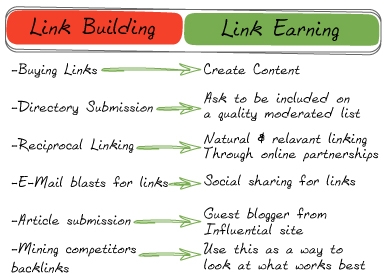
Link earning is an important aspect of content marketing and has been recognized as an effective means to increase the rankings of your website.

Why Link Earning is important?

Some argue that it makes them a bit of confuse over the  transition from the previous approach of link building to link earning.I would like to clarify this confusion by saying that there is a stark difference between earning and demanding.

The current set of visitors never likes to be misguided, instead they like point by point data or content.Link building as a whole, requires unique & relevant content targeting the right traffic. Both goes hand in Hand! In layman terms,Link building is a homogeneous mix of content and the readers.

Earning is definitely an arduous task, as it would require a strategic effort to bring your website to a respectable position but believe me the effort is worth it!
Everybody expects relevant results from Google. Having irrelevant or shady sites ranking in the top of the search results helps neither you, the visitor, nor Google the search engine. This is one reason why Google works hard to improve their algorithms in order to rank those that deserve to be there.

Image Courtesy : cognitiveseo

You could earn links by following:

  1. Creating epic content that was so engaging people naturally linked to it in the course of their editorial and online work;
  2. Promoting your content so that it gets in front of the right people, who are naturally motivated to share and link to your content;
  3. Building relationships that give influencers in your space comfort in the fact that your work is high quality and valuable enough to share.
Earning links still requires a strategic approach, but it’s less about creating artificial structures that result in links or treating links like a numbers game. The focus, as with other areas of SEO, is on quality and value. Still, there’s an active place for building: instead of focusing on building links, focus on building your brand. If you’re creating high quality content that you’re placing in priority outlets, links will naturally follow as a by product of that work.

How to Evaluate the Quality of a Link:

Google’s Penguin update underscored the importance of the quality of your links. Nothing can damage your site’s credibility and rankings faster than sketchy links. As a result, it’s critical to assess the quality of a potential link if you’re working to cultivate those connections. Here’s a quick guide of questions to ask before actively pursuing a link to your site:
  • Is the site topically relevant to my content?
  • Is the design and organization clean and professional?
  • What’s the quality of the content that it publishes?
  • Is the site overrun with advertising?
  • Does the site have an active community, as evidenced by comments, social media engagement, and mentions?
  • What does their incoming link profile look like?
  • Is there a clear editorial hand at work developing and selecting content?
  • Would I be comfortable associating my brand with this site?
By shifting your focus away from tactics that build links and instead investing in earning them, you’re creating a foundation that help you attract links from the top authorities in your space. One of the best strategies for doing so is through content marketing; in the next chapter, we’ll take a closer look at what you need to know about content marketing and inbound strategies that work.

Continues .....

SEO Tips - Top 10 SEO Blog You Should Refer in 2016

It's been said again and again ,I'll say it again: SEO is something which is constantly changing. One of the best ways to keep up with SEO update is to follow some of the top SEO blogs in the industry.Its not all of them but yes you can stay update by following these blog

What you want to look for in a SEO blog is not only that it covers the latest SEO news, but that it also takes that news and analyses what it means for your brand company or clients. These topics, in addition to other relevant "how-to" articles, videos, and guides, are what make an SEO blog stand out against the rest.

You see where this is going: I found few of the best that really fit this criterion and have great potential for 2015.

Google's Official Blog

The Google Blog. This is obviously a blog that never gets old. It's always updated, it's always correct, and it's always something you should be reading.This blog is purely for the latest news , update on product , events and glimpses of life inside Google.

The Popular Names in SEO industry 

Search Engine Land.“Search Engine Land is a must read hub for news and information about search engine marketing, optimization and how search engines such as Google, Yahoo, Microsoft Live.com and Ask.com work for searchers” Arguably the most popular SEO blog around, this one seems to have it all. It is always the first to break news, and you'll find that they have several articles on one subject, so all of your questions can be answered right on this blog. You'll find that most of the writers are the same each day, but the topics definitely have good variety.

Search Engine Watch.“A guide to search engine marketing and search engine optimization. Forums, reviews, articles, ratings, and frequent newsletters.”This is also one of the main blogs out there on the web for SEO. While Search Engine Land is typically the first to break news and get it out there, Search Engine Watch still covers the news and always seems to publish just a little bit more frequently and add just a little bit more information. In other words, reading both is beneficial.

Search Engine Journal. This blog thrives on guest contributors, so you're always getting different topics and different voices. It still covers news like the other two main websites, but this one seems to have a little bit more fun with videos, great comments, and some of the most detailed content around.

Moz. Moz has been in the SEO game since 2004, publishing some of the best guides available for beginners. They also publish quite a bit of advanced material and keep things very detailed, so just about any small business can benefit. They don't report SEO news quite as much as the others, but they delve into popular topics frequently.

The Blogs Not to Miss

KISSmetrics.This is a cool blog because it puts a focus on data & metrics and is incredibly thorough . Although they do cover other subjects besides just SEO, they publish frequently enough that there is almost always a few articles each week that can help your SEO efforts. If you're looking for content that is detailed and covers every angle of a topic, this is your blog.

HigherVisibility. This is one of those SEO blogs that focuses quite a bit on the "what it means to you" aspects of everything SEO. It doesn't just tell you the news and what it might mean, but it actually gives you steps and tools to put something in place to take action on your website. In other words, it's one of the best out there if you're really looking for useful advice about improving your SEO.

SEMRush. SEMRush is a company that does more than just blog (they offer one of the best SEO site audit tools on the market), so they really know their stuff. You'll see guest authors on this blog occasionally and it's always updated with the latest information. Like HigherVisibility, there is a lot of advice found here that you can really take and put into practice.

HubSpot. The greatest thing about this blog is the way it's written. The articles have a conversational tone and have done a good job "humanizing" the content to make it easy to understand. The Marketing Blog is where you're going to find your SEO advice, but HubSpot also has blogs covering other topics (sales, academy, web design, etc.) that I recommend checking out.

Mattcuts.com. This blog is belongs to former web spam Team Head .This blog contains post related to technology , gadget & SEO.

ShoutMeLoud This blog is about blogging tips and technology, its popular one among  all the bloggers however you can get very helpful tips regarding SEO and Word Press.

Google AdWords - what is changing and what is not on Google desktop search results.

on Tuesday, 23 February 2016
Last Friday, February 19, 2016, Google confirmed that search results pages on desktop will no longer show text ads in the right sidebar. Instead, as many as four text ads will display above the organic search result, and three text ads on the bottom of the page .

Image Courtesy : sriconsultancy

What Exactly Is Changing?
All of the changes confirmed on Friday pertain to desktop search results on Google.com and Google search partners.


There are a few elements included in the changes to desktop results:


  • No text ads will be served on the right rail of the search results on desktop.
  • Google will serve four text ads instead of three in the mainline area above the organic listings for more “highly commercial queries” (More on that below).
  • Three text ads will show at the bottom of the SERPs.
  • The total number of text ads that can appear on a SERP will shrink from as many as 11 to a maximum of seven.
  • Product listing ad blocks and Knowledge Panels (sometimes with ads, as tests continue in these spaces) will show in the right rail on relevant queries.